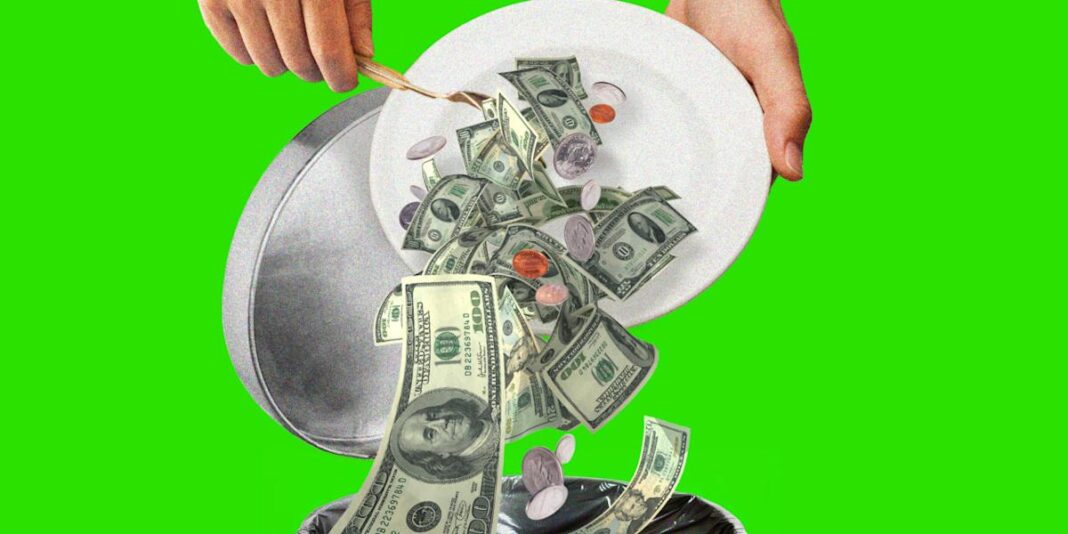
Boomers are more wasteful in certain spending categories than their younger counterparts. These habits can be harmful for the many people in this cohort who are financially vulnerable. – MarketWatch photo illustration/iStockphoto
The wasteful habits of millennials and Gen Z members should come as no surprise — it has been well documented that many of these consumers are prone to impulse online spending and have grown addicted to the convenience of delivery apps.
But new survey data show that baby boomers — America’s richest generation and one often perceived as being thriftier those that followed — are more wasteful in certain spending categories than younger people. And those habits can be especially harmful for the many people in this unevenly wealthy cohort who are financially vulnerable.
Specifically, baby boomers are more likely than the average consumer to waste food by throwing out leftovers or expired items, to leave appliances or utilities running unnecessarily, to buy brand-name pantry items and to buy lottery tickets, according to a recent survey by Motley Fool Money.
And these habits have only gotten more expensive: Food prices increased by 2.9% in January compared with a year earlier, gas utility costs rose by 9.8% and electricity went up 6.3%, according to the latest figures from the Bureau of Labor Statistics.
“Once you are drawing from savings instead of building it, small recurring expenses matter more,” said Melissa Caro, a financial planner and founder of My Retirement Network, a financial education site. “Utilities, food waste and lifestyle inflation can quietly erode cash flow over a 20- to 30-year retirement. Even households with meaningful assets need to manage longevity risk, healthcare uncertainty and rising living costs.”
Boomers — who were born between 1946 and 1964 — were more likely than Americans on average to waste money during shopping trips, while on vacation or for special occasions, the poll of 2,000 U.S. adults found. Their most common trigger was sales and discounts.
On the other hand, millennials, who were born between 1981 and 1996, and Gen Z, born between 1997 and 2012, were more likely to waste money online late at night. Members of Gen X, born between 1965 and 1980, were the most vulnerable to emotionally driven shopping but, along with boomers, were much more likely than younger generations to resist social-media trends and peer influence, the Motley Fool survey showed.
Despite their wasteful ways, boomers are the wealthiest cohort in U.S. history. Many were buoyed by the postwar economic boom, access to affordable college educations and workplace pensions, and growth in the housing and stock markets, MarketWatch recently reported.
In line with broader trends in the economy, however, their wealth is not evenly distributed across the generation. Pew Research Center found that the top 10% of boomer households owned 71% of the generation’s overall wealth.
For instance, Americans 70 to 74, who fall in the middle of the current boomer age range, have a median net worth of about $476,000, including home equity, MarketWatch previously reported — meaning half of the people in that group have a net worth that is lower. The net worth for those in the 90th percentile is nearly $3.3 million, or 6.8 times the median.
This wealth gap suggests that for many boomers, wasteful spending habits could have a meaningful impact on their financial well-being.
The “huge inequality within the boomer generation itself” means “some have paid-off homes and strong portfolios. Others rely almost entirely on Social Security and have very little margin for error,” Juan G. HernandezAriano, a financial planner and principal at WealthCreate, told MarketWatch.
In his experience, boomers are largely “pretty cost-conscious in day-to-day spending,” but many are casual about larger financial decisions that “slowly chip away at retirement security,” such as underestimating healthcare expenses or being overly conservative with their investments.
Only 40% of boomers — the youngest of whom are already 62 years old — are ready for retirement, Vanguard estimates, meaning their projected sustainable income exceeds their spending needs. These people are “concentrated among the top 30% of income earners.”
There are other signs that many boomers may be victims of poor spending habits: More reported living paycheck to paycheck — meaning their spending on necessities took up more than 95% of their income — in 2025 than in 2023, according to the Bank of America Institute.
The average credit-card debt was $6,795 for boomers, 82.9% of whom had credit-card debt in 2025, a higher rate than millennials (77.9%) or Gen Z (72.2%), according to Experian. They were also the most likely to have home-equity lines of credit.
Some may not even be aware of their spending habits. Boomers were more likely than other generations to say they never waste money — but “that doesn’t mean that there isn’t waste. It just shows up a little differently,” Joel O’Leary, personal finance expert at Motley Fool Money, told MarketWatch. “It’s more like throwing away unused groceries or continuing to go to Costco or some of those expensive stores and buying in bulk, and then throwing away much of it.”
Wasteful habits are harmful when they start to impact financial security. While one-third of baby boomers said they had to tap their emergency savings in the last 12 months,16% of people in this age range said they have no emergency savings, according to 2025 Bankrate data.
Like any consumer, boomers who want to avoid wasting money can consider tracking and analyzing expenses and cutting back on expenses that don’t actually improve their quality of life.
While Caro “wouldn’t describe wasteful spending as a defining boomer trait,” she noted that “many boomers were raised by parents who lived through the Great Depression. That experience tends to produce strong money beliefs — sometimes in the direction of extreme thrift, and sometimes in the opposite direction. In families where scarcity was intense, the next generation can either internalize ‘waste not, want not’ or subconsciously react against it.”
We came across a bullish thesis on Omnicom Group Inc. on X.com by @MoneyShow. In this article, we will summarize the bulls’ thesis on OMC. Omnicom Group Inc.'s share...