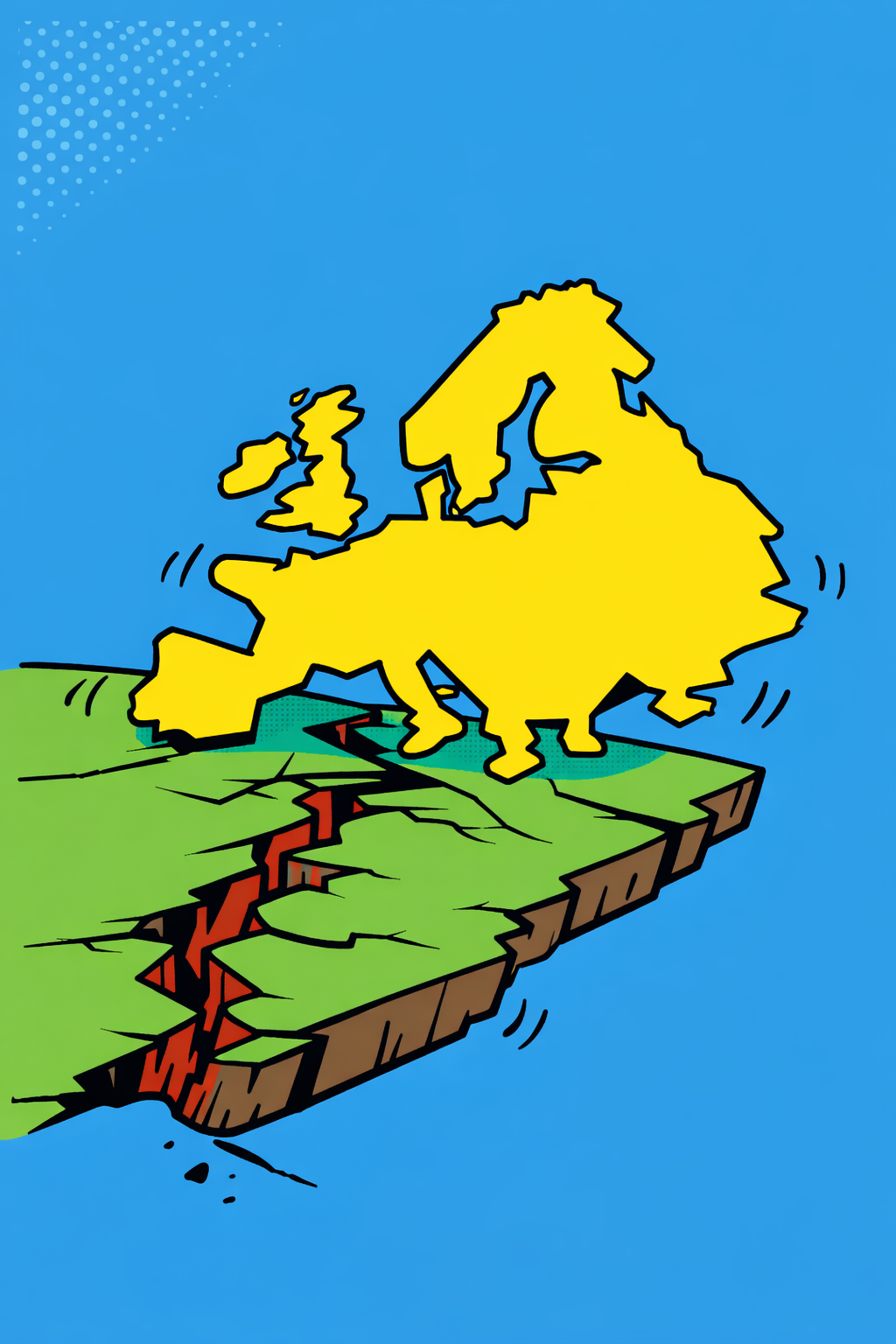
Europe Jolted as Oil Spikes and War Risk Surges – Moby
European markets started the week with a thud as a dramatic escalation between the US, Israel, and Iran sent oil surging and investors scrambling for cover. Defense stocks flew, airlines sank, and the old inflation trade came roaring back.
European equities opened sharply lower after a weekend of U.S. and Israeli strikes on Iran and swift retaliation from Tehran rattled global markets.
The pan-European Stoxx 600 fell around 1.5% to 2% in early trading, with major bourses from Frankfurt to Paris and Milan deep in the red. Germany’s DAX dropped more than 2%, France’s CAC 40 slid over 2%, and Italy’s FTSE MIB lost close to 2%. London’s FTSE 100 held up slightly better but was still down more than 1%.
The selloff followed heavy losses in Asia and weakness in US futures, as investors reacted to the widening conflict and the risk of prolonged disruption in the Middle East.
Energy markets delivered the real shock. Brent crude jumped roughly 8% to 10% at one point, trading near $79 to $80 a barrel, while US crude also surged. European gas prices spiked sharply, with benchmark contracts climbing more than 20% as concerns mounted over flows through the Strait of Hormuz, a chokepoint that handles a significant share of global oil and liquefied natural gas shipments.
Safe-haven assets rallied. Gold rose more than 2%, and volatility gauges jumped as traders priced in a higher risk premium.
Sector moves were stark. Energy majors and oil exporters outperformed, with companies like Equinor and other North Sea producers rising strongly. Defense stocks were also bid, including BAE Systems, Leonardo, Saab, and Renk, as investors anticipated higher military spending in an already tense geopolitical environment.
On the flip side, airlines, cruise operators, and travel companies slumped on fears of higher fuel costs and airspace disruption. Carnival, Lufthansa, and other carriers were among the sharpest fallers. Banks and technology shares also weakened as risk appetite faded.
Markets are not just reacting to missiles. They are reacting to math.
When oil jumps 8% in a morning, every macro model in Europe starts flashing amber. Energy feeds directly into headline inflation, squeezes household spending, and complicates life for central bankers who had only just begun to see clearer skies.
Our analysts just identified a stock with the potential to be the next Nvidia. Tell us how you invest and we’ll show you why it’s our #1 pick. Tap here.
For the European Central Bank, this is awkward timing. Inflation had been easing, growth was fragile but stabilizing, and the path toward further rate cuts looked plausible. A sustained move in oil toward $80 or above does not just lift petrol prices. It seeps into transport, manufacturing, chemicals, and food. It shifts inflation expectations, which are notoriously hard to re-anchor once they drift.
There is also a structural layer to this story. Europe remains highly sensitive to disruptions in global energy supply, even after cutting its direct reliance on Russian pipeline gas. The Strait of Hormuz is not a distant headline. It is a live artery of global energy trade. Any prolonged disruption forces Europe to compete harder for cargoes, often at higher prices.
That is why gas jumped so violently. Traders remember 2022. They remember how quickly energy scarcity translated into factory shutdowns, emergency subsidies, and political strain. Even if this conflict does not escalate further, the reminder alone is enough to reset risk premiums.
Defense stocks tell a parallel story. Investors have already piled into the sector over the past year on expectations of rising European military spending. Fresh conflict reinforces that thesis. Governments rarely cut defense budgets during instability. They expand them. The logic is brutally simple.
But a valuation question lurks beneath the rally. European defense names have re rated aggressively. If spending rises faster than expected, margins may not necessarily follow. Political scrutiny often increases alongside budgets. Still, in moments like this, markets prefer revenue visibility over margin nuance.
The travel sector’s slump shows how quickly sentiment can flip. Airlines had been enjoying steady demand and lower fuel volatility. A spike in oil, combined with potential airspace closures and security concerns, hits both costs and bookings. Even if flights continue, perception matters. Travelers react to uncertainty.
More broadly, this episode exposes how thin the buffer has become between geopolitics and markets. For much of the past decade, investors learned to discount distant conflicts. This time feels different because energy is directly in the line of fire. When tankers hesitate and shipping routes narrow, it is not abstract.
The real question is duration. A brief spike in oil can be absorbed. A sustained disruption changes earnings forecasts, inflation paths, and policy assumptions across the continent.
Markets will now trade headline by headline. Investors will watch oil and gas prices as the purest barometer of escalation risk. If crude stabilizes below recent highs and shipping flows resume more normally, equities may claw back losses and volatility could fade.
If energy prices continue climbing and military exchanges widen, the conversation shifts from short-term shock to macro regime change. In that world, rate-cut expectations are pushed out, growth forecasts are trimmed, and defensive sectors stay in favor.
For now, Europe is not in panic. But it has been sharply reminded that, in a world of live geopolitical fault lines, energy is still the market’s quickest trigger.
One stock. Nvidia-level potential. 30M+ investors trust Moby to find it first. Get the pick. Tap here.