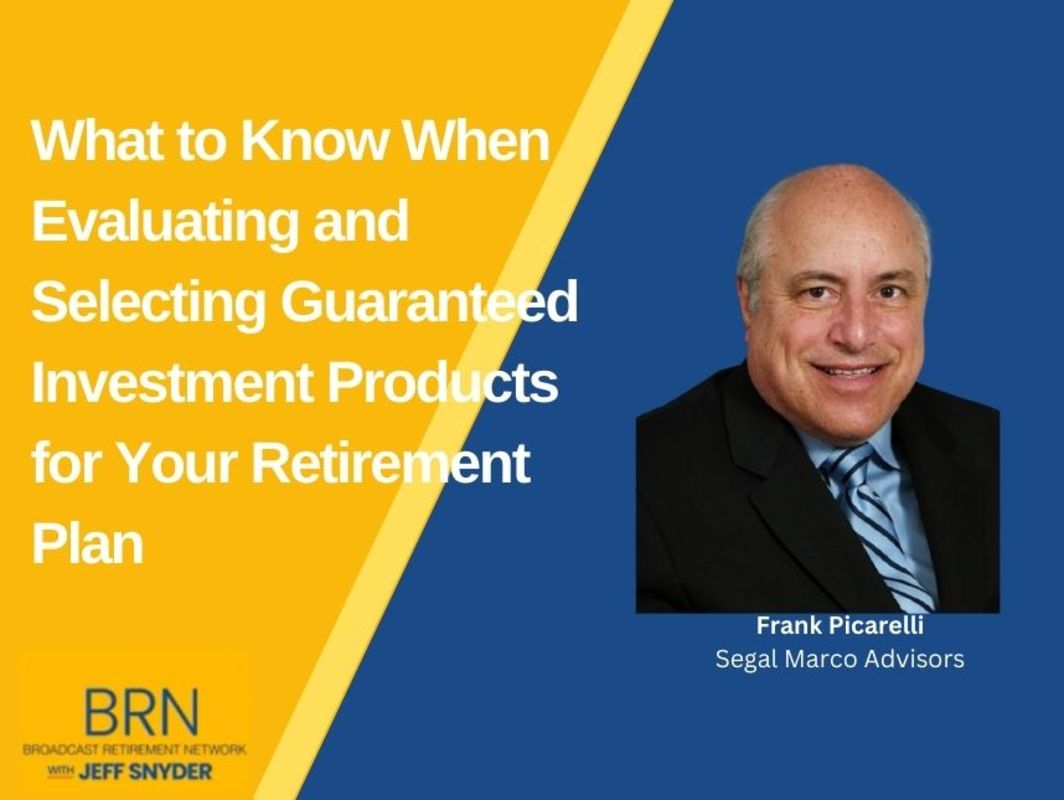
Broadcast Retirement Network’s Jeffrey Snyder discusses how employers should select guaranteed investment products for their 401k, 403b and 457b retirement plans with Segal Marco Advisors’ Frank Picarelli.
Jeffrey Snyder, Broadcast Retirement Network
Joining me now is Senior Vice President of Siegel Marco Frank Piccarelli. Frank, it’s always great to see you. Thanks for joining us this morning.
Frank Picarelli, Segal Marco Advisors
Hey Jeff, it’s great to see you. It’s been a long time.
Jeffrey Snyder, Broadcast Retirement Network
It has been, but you know, we have stayed in touch. And for the audience, full disclosure, I have known Frank Piccarelli for close to 18 years. We’ve worked together, we stay in touch.
He to me is considered one of the OGs, one of the great consultants in the retirement industry. And I thought he could share a lot of expertise related to stable value. Frank, let’s kind of get into it because stable, you’re quite welcome, it’s well-deserved.
Stable value has been a core component of defined contribution investment lineups. But in your perspective, how important is it in today’s defined contribution world?
Frank Picarelli, Segal Marco Advisors
Well, clearly it’s a required asset in any core lineup that you want to have participants have an investment option for preservation of principle and capitalization. So clearly, it plays a different role in different markets. In the government world, you know, it’s driven by the insurance industry.
And, you know, it’s been a mainstay in governmental 457 plans. And there’s different products that are out there, different way it operates in terms of disclosure of fees, declaring rates at the beginning of the periods, et cetera. And then there’s in the corporate world, you know, which is driven more by the mutual fund world, you don’t see it as prevalent as an option.
They tend to use money market funds, which are more responsive than current interest rates. So it’s a different audience. Government employees by their nature tend to be a little more conservative.
By working for a government, they tend to follow that philosophy in terms of their investments. And in terms of asset allocation, you always need a sleeve of it in your overall portfolio. Protection of the ups and downs of what we see what’s going on in the market.
Jeffrey Snyder, Broadcast Retirement Network
And, Frank, I mean, I’ve read studies where 40% of government, and that’s an area of clear expertise for you and the Siegel Company, 40% of assets typically in governmental 457 plans in these types of products. Let me ask you, would you mind telling us about the different types of products? Because there are, at the very high level, there’s different structures, right?
So do you mind just kind of walking us through those structures?
Frank Picarelli, Segal Marco Advisors
Sure. There’s really basically two main structures. Traditional structure is an insurance annuity, which we call a general account product.
That’s a product that’s backed by the general assets of the insurance company. Traditionally, it doesn’t disclose its fees. It’s a spread product.
So we may be earning 3% to the participants and the insurance company is earning something else. It could be greater than that. They have basically some restrictions around the portability issues.
And a key thing when evaluating those products is you really got to understand the exit strategy associated with that. And then there’s the separate account products, which all, it was a gold rush to move more and more products from general accounts to separate accounts. And consultants were doing that more to get the exposure on fees and have fee transparency, which is, you know, has its benefits, of course.
And then the individual securities are owned by the plan. Plan sponsors have more of an active role in the oversight of those underlying securities in that portfolio. They tend to outsource it to the investment manager, but you really got to stay on top of it.
A good consultant will always manage what’s going on under the hood on the separate account and their portability features are more flexible. You could transfer the securities in kind to a successor manager. But, you know, I never see the situation.
In reality, when I go through all of these searches, at the end of the day, the successor vendor or investment manager, they want to get everything over in cash. So there’s pluses and minuses with each product. And, you know, you really got to understand the differences and really understand the out provisions of these products.
Jeffrey Snyder, Broadcast Retirement Network
Yeah, really. And you hinted to this on this, the due diligence. And this is an area of strength.
I know, you know, again, you have spent, I don’t want to out your age, but you have spent several, as have I, I’ve spent several decades, but you’ve spent more time in this stable value space. It’s key part of what you do. And of course, Siegel Marco, how do you perform due diligence, whether it’s that general account product or that separate account product?
What do you need to know when you’re looking under the hood, to use your metaphor?
Frank Picarelli, Segal Marco Advisors
Well, you know, I worked, I started my career many moons ago with a large insurance company and I worked in the stable value area. So I had a very good knowledge of the basic contract, contract provisions, the actuarial side of the product. And through the years doing vendor search projects and working with that, it’s a whole different evolution of looking at the products.
I’m very fortunate that I work for an organization that has tremendous bench strength in looking at the underlying investments under the hood. So when they look at stable value, they look at the composition of the portfolio, the manager on the fund, the credit quality of the underlying securities. So they could really rate and differentiate one investment policy from the other.
It’s like looking at a bond fund, okay? And looking at all of the possible bond managers. Then in defined contribution plans, especially in the government space, you need someone to wrap that separate account and looking at the wrap providers, their financial strengths, their risk-based capital to supply that guarantee.
On general accounts, it’s pretty much, you know, this is the product. So, you know, you look at that and you look at their investment policy statement that they have in place. You look at the types of securities, the underlying strategy of the manager in terms of its holdings, and you explore the contract provisions, looking at the exit provisions.
Are you going to get a book out distribution at settlement? Are you going to get installment distributions at settlement? So many times, you know, clients, they’re out there, they look for the best to give the participants the highest interest rate at the lowest possible fee.
That’s great. A general account may offer those features and really be more superior than a separate account product, but you have to understand the exit strategy. So my experience in the industry is working on RFPs is more contract strategies.
I was just working on an RFP project. I spent more time working with the vendor on their exit strategy than really, you know, going forward because I knew the standard parameters of their contract. So the flexibility, the portability is really important.
You don’t want to get yourself locked in. So many clients are being challenged. They want to take their service provider out to bid, but they realize they have, they’re in a general account, and they have this huge book to market differential, and there’s a big cost involved with that in moving the plant.
I’m not saying it can’t be done, but a good consultant would look at that and basically when they go out to bid, make sure that the vendor community really understands what that differential is. And they’re all bidding on a common plant, common assumptions across the board. So they all know that.
So a lot of good data, I believe is essential. Cashflow analysis, the number of participants, the utilization, all of that to give to the actuaries so they could understand the client, the unique client relationship. Separate accounts, I use a lot in the larger plants where we have a billion dollars in assets and you want to keep diversification in the portfolio.
So you may have it carved out with a general account piece that may be generating a higher yield and then diversification of having separate individual bond managers wrapped by an insurance company to give you diversification. So it’s a combination. It depends on the situation, the size of the plan, but you’ve got to look at what’s the right product for the client and understanding the client needs and that’s a key factor as a consultant when you go through and evaluating it.
But I’m very fortunate to have the research capabilities to really look at all of the dynamics that you would use to evaluate a stable value product like you would look at a mutual fund.
Jeffrey Snyder, Broadcast Retirement Network
Yeah. Well, yeah, Frank, I mean, it’s certainly, I think an underappreciated part. In a lot of cases, it makes up a significant portion or a big portion, a great proportion of the assets in a retirement plan.
But I think as you got into, you can’t look at these things very superficially. You got to drill down at obviously an area of strength for you and Siegel Marco. Frank, we’re going to have to leave it there.
Always great to see you and look, we look forward to having you back on the program again very soon, my friend.
Frank Picarelli, Segal Marco Advisors
Well, thank you for your time today, Jeff. It’s always great to see you. Continue all of the great things you do in informing the investment community about their options and what’s available to them.
This story was originally published by TheStreet on Mar 4, 2026, where it first appeared in the Retirement section. Add TheStreet as a Preferred Source by clicking here.