


After months of discussion around President Donald Trump’s signature One Big Beautiful Bill Act (OBBBA), financial advisors and clients are finally feeling the impact this tax filing season.
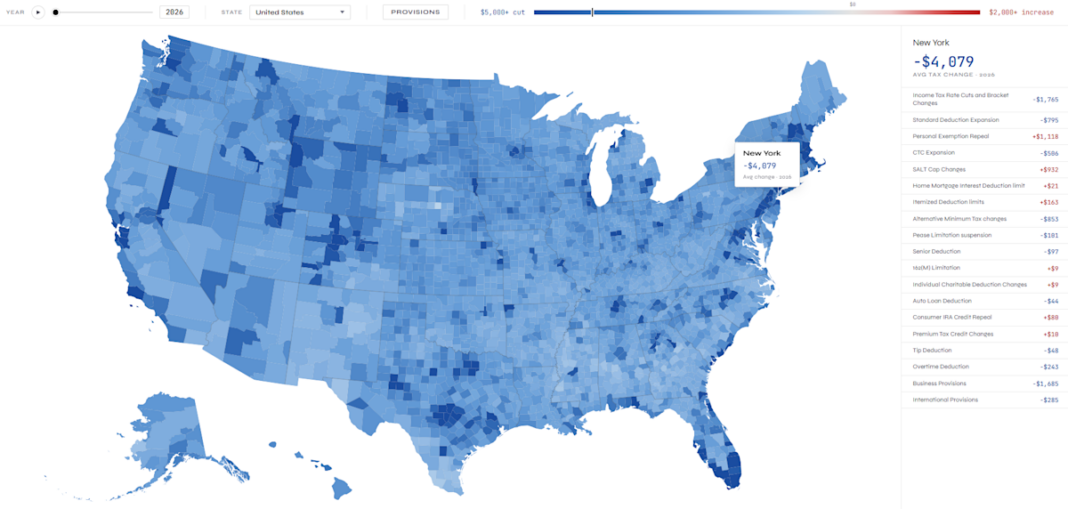
New data from the nonpartisan, nonprofit Tax Foundation shows exactly how the changes will affect individual taxpayers across the country, offering the first geographically detailed and dollar‑focused picture of the law’s implications for households and planning strategies.
The Tax Foundation researchers analyzed the effects of OBBBA by first estimating national tax changes using its general equilibrium model. They then distributed those changes to counties based on 2022 IRS data, which shows how different taxpayers filed in each area.
Their approach accounted for key OBBBA provisions, including adjustments to itemized deductions, charitable contributions, standard deductions and more, allowing them to provide a detailed, county-by-county view of who benefits or pays more under the law.
READ MORE: Private markets in 401(k)s face major liquidity challenges: Morningstar
Nationally, the average tax cut per filer will be $3,813 in 2026, according to Tax Foundation data, driven by a combination of individual and business tax changes under the bill.
Individual tax changes, like expanded deductions and credits, account for about $2,272 of that average cut, while business tax provisions contribute roughly $1,541 per taxpayer. Tax Foundation researchers project that the average tax cut will dip to about $2,590 in 2030 as some deductions phase out, then rise again to around $3,163 by 2035 as inflation pushes the permanent provisions’ nominal value higher.
Despite broad benefits, geographic disparities stand out. Taxpayers in Wyoming ($5,478), Washington ($5,445) and Massachusetts ($5,259) will see the largest average tax cuts in 2026, while filers in states such as West Virginia ($2,448) and Mississippi ($2,386) receive the smallest.
Teton County, Wyoming, in particular, will experience an exceptional $39,316 average cut per taxpayer, the highest in the country, with Pitkin County, Colorado ($22,717) and Summit County, Utah ($15,477) following closely — likely reflecting the law’s benefit to higher‑income households and business owners in those areas. By contrast, more rural counties like Loup County, Nebraska (about $731) will see much smaller average cuts.
READ MORE: Donor-advised fund lawsuit pits successor advisor against sponsor
According to the Tax Foundation, much of the projected tax relief stems from OBBBA locking in the individual income tax provisions of the 2017 Tax Cuts and Jobs Act. By making those rates, brackets and deduction rules permanent, the law prevents what would have been a tax increase for roughly 62% of filers in 2026, had the TCJA expired. In other words, a significant share of the “cut” reflects avoiding higher taxes rather than introducing entirely new breaks.


