


Crypto companies have transformed from afterthought advertisers to the backbone of the affiliate marketing businesses. I also saw crypto exchange revenue grow from essentially nothing to roughly 25% of our total income in a single year. The reason was simple: these companies were desperate.
Banned from advertising on Google, Facebook, and most mainstream channels, crypto and trading firms were willing to test any platform that could deliver volume. Their marketing teams threw money at affiliate sites, influencers, and anyone who could generate leads.
Read more: Google Lifts IG France’s Ads Restriction after 7 Years, Account Openings Double
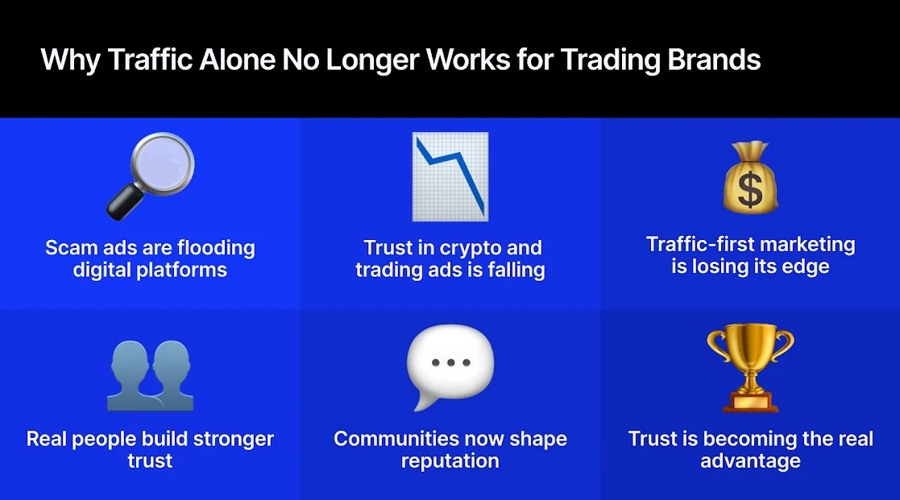
But here is what I have learned since then, both from running that business and from watching it eventually go bankrupt after a Google algorithm change: the traffic-first approach is fundamentally broken. And the trust deficit it creates is becoming an existential threat to legitimate trading and crypto companies.
The Fraud Epidemic Is Poisoning the Well
The scale of fraud in digital advertising is staggering. According to internal Meta documents uncovered by Reuters, the company estimated that approximately 10% of its 2024 sales, roughly $16 billion, came from running ads for scams and banned goods. These included fraudulent investment schemes, celebrity crypto-scams, illegal online casinos, and deceptive e-commerce promotions. Meta reportedly shows users an estimated 15 billion of these higher-risk scam ads daily.
In our latest 2026 Crypto Crime Report chapter, we examine how crypto scams reached $17 billion in 2025, driven by sophisticated operations using AI, phishing-as-a-service tools, and professional money laundering networks. Our analysis reveals that impersonation scams grew 1400%… pic.twitter.com/ioiVFu4OJv
— Chainalysis (@chainalysis) January 13, 2026
For legitimate crypto exchanges and trading platforms, this creates an impossible environment. When consumers scroll through feeds saturated with investment scams wearing the same visual language as your legitimate platform, how can they tell the difference? The answer, increasingly, is that they cannot, and they are choosing not to trust anyone.
This is not just a perception problem. An academic paper published in the Journal of Financial Economics in 2025 demonstrates that trust functions as a genuine entry barrier in financial services. The study, which analysed the Wells Fargo scandal’s impact on fintech adoption, found that a one standard deviation increase in exposure to the bank scandal led to a 4.1% increase in the probability of consumers choosing alternative fintech lenders. Trust, once broken, does not just hurt one company. It reshapes entire markets.
The Death of Traditional Trust Signals
The channels that once built credibility are collapsing or becoming contaminated. Traditional media continues its decline, making PR coverage less effective at generating the trust it once did. A mention in a respected financial publication used to mean something; now, readers automatically assume the coverage was paid for.
Affiliate sites have developed a terrible reputation. Too many operate as thinly veiled advertising vehicles, recommending whichever product pays the highest commission rather than what is genuinely best for the consumer. Influencer marketing faces similar credibility issues, with audiences increasingly sceptical of endorsements from people who are clearly paid to promote products they have never actually used.
This is why we are seeing a mass migration to Reddit and other community platforms. Users want opinions from other real users, not from websites or influencers with obvious financial incentives. Many fintechs are now investing heavily in Reddit presence, recognising that peer recommendations carry more weight than any amount of paid advertising.
Read more: “Official Fintech Partner” – FX Firms Found Value in Sports Beyond Just Branding
The Trust Building Playbook for Trading and Crypto Companies
If you are running a legitimate crypto exchange or trading platform, here is what I believe you need to embrace:
Turn your employees into ambassadors. Real people with real LinkedIn profiles talking authentically about your company and industry carry more weight than polished marketing copy. When prospects can verify that actual humans work at your company and believe in what they are building, trust follows.
Embrace organic social media and community engagement. Run AMAs on Reddit. Respond to criticism publicly. Show up in the conversations that are already happening about your industry rather than just broadcasting marketing messages.
Do not shy away from old-school brand building. PR, billboards, and even TV ads serve a different purpose than digital performance marketing. They signal permanence and legitimacy. Scam operations do not invest in brand awareness campaigns because they will not be around long enough to benefit from them.
Prioritise real customer testimonials and verifiable proof. With the rise of AI-generated content, anything that proves authenticity becomes more valuable. Video testimonials from real customers, employee spotlights with verifiable LinkedIn profiles, and documentation of your regulatory compliance all signal legitimacy in ways that polished marketing copy cannot.
The Brand Awareness Paradox
Here is something I have observed that creates a strategic dilemma: affiliates, AI-generated content, influencer campaigns, and social media ads might still bring traffic, but they put you in the same bucket as the scammers using identical tactics. The reputational damage from these channels is inversely proportional to your existing brand recognition.
Related: Has the Quality of Online Content Suffered with the Proliferation of AI?
If you are Coinbase or Robinhood, you can run performance marketing campaigns with limited brand risk. Consumers already know who you are, but your legitimate ads will invariably compete with scammers using your brand name to defraud people, so it’s not risk-free. But if you are a newer or smaller player, those same tactics can actually hurt you by associating your brand with the sketchy ecosystem of crypto advertising.
This means emerging platforms need to overinvest in trust-building channels early, even if the short-term ROI looks worse than performance marketing. The long-term payoff comes from building the brand recognition that eventually makes other channels viable.
Trust Is the New Competitive Advantage
The research is clear: trust is a fundamental driver of market share. When trust in incumbent institutions erodes, consumers actively seek alternatives. When trust in an entire category is damaged, the companies that can credibly differentiate themselves capture disproportionate value.
For trading and crypto firms, this represents both a threat and an opportunity. The threat is obvious: the flood of scams is poisoning consumer trust in the entire category. The opportunity is that legitimate players who invest seriously in building trust will find themselves with a durable competitive advantage as the industry matures.
Trust is scarcer than ever. Every channel that can generate it should be favoured over channels that merely generate traffic. The companies that understand this distinction will be the ones still standing when the current era of crypto marketing chaos finally settles into something more sustainable.
Crypto companies have transformed from afterthought advertisers to the backbone of the affiliate marketing businesses. I also saw crypto exchange revenue grow from essentially nothing to roughly 25% of our total income in a single year. The reason was simple: these companies were desperate.
Banned from advertising on Google, Facebook, and most mainstream channels, crypto and trading firms were willing to test any platform that could deliver volume. Their marketing teams threw money at affiliate sites, influencers, and anyone who could generate leads.
Read more: Google Lifts IG France’s Ads Restriction after 7 Years, Account Openings Double
But here is what I have learned since then, both from running that business and from watching it eventually go bankrupt after a Google algorithm change: the traffic-first approach is fundamentally broken. And the trust deficit it creates is becoming an existential threat to legitimate trading and crypto companies.
The Fraud Epidemic Is Poisoning the Well
The scale of fraud in digital advertising is staggering. According to internal Meta documents uncovered by Reuters, the company estimated that approximately 10% of its 2024 sales, roughly $16 billion, came from running ads for scams and banned goods. These included fraudulent investment schemes, celebrity crypto-scams, illegal online casinos, and deceptive e-commerce promotions. Meta reportedly shows users an estimated 15 billion of these higher-risk scam ads daily.
In our latest 2026 Crypto Crime Report chapter, we examine how crypto scams reached $17 billion in 2025, driven by sophisticated operations using AI, phishing-as-a-service tools, and professional money laundering networks. Our analysis reveals that impersonation scams grew 1400%… pic.twitter.com/ioiVFu4OJv
— Chainalysis (@chainalysis) January 13, 2026
For legitimate crypto exchanges and trading platforms, this creates an impossible environment. When consumers scroll through feeds saturated with investment scams wearing the same visual language as your legitimate platform, how can they tell the difference? The answer, increasingly, is that they cannot, and they are choosing not to trust anyone.
This is not just a perception problem. An academic paper published in the Journal of Financial Economics in 2025 demonstrates that trust functions as a genuine entry barrier in financial services. The study, which analysed the Wells Fargo scandal’s impact on fintech adoption, found that a one standard deviation increase in exposure to the bank scandal led to a 4.1% increase in the probability of consumers choosing alternative fintech lenders. Trust, once broken, does not just hurt one company. It reshapes entire markets.
The Death of Traditional Trust Signals
The channels that once built credibility are collapsing or becoming contaminated. Traditional media continues its decline, making PR coverage less effective at generating the trust it once did. A mention in a respected financial publication used to mean something; now, readers automatically assume the coverage was paid for.
Affiliate sites have developed a terrible reputation. Too many operate as thinly veiled advertising vehicles, recommending whichever product pays the highest commission rather than what is genuinely best for the consumer. Influencer marketing faces similar credibility issues, with audiences increasingly sceptical of endorsements from people who are clearly paid to promote products they have never actually used.
This is why we are seeing a mass migration to Reddit and other community platforms. Users want opinions from other real users, not from websites or influencers with obvious financial incentives. Many fintechs are now investing heavily in Reddit presence, recognising that peer recommendations carry more weight than any amount of paid advertising.
Read more: “Official Fintech Partner” – FX Firms Found Value in Sports Beyond Just Branding
The Trust Building Playbook for Trading and Crypto Companies
If you are running a legitimate crypto exchange or trading platform, here is what I believe you need to embrace:
Turn your employees into ambassadors. Real people with real LinkedIn profiles talking authentically about your company and industry carry more weight than polished marketing copy. When prospects can verify that actual humans work at your company and believe in what they are building, trust follows.
Embrace organic social media and community engagement. Run AMAs on Reddit. Respond to criticism publicly. Show up in the conversations that are already happening about your industry rather than just broadcasting marketing messages.
Do not shy away from old-school brand building. PR, billboards, and even TV ads serve a different purpose than digital performance marketing. They signal permanence and legitimacy. Scam operations do not invest in brand awareness campaigns because they will not be around long enough to benefit from them.
Prioritise real customer testimonials and verifiable proof. With the rise of AI-generated content, anything that proves authenticity becomes more valuable. Video testimonials from real customers, employee spotlights with verifiable LinkedIn profiles, and documentation of your regulatory compliance all signal legitimacy in ways that polished marketing copy cannot.
The Brand Awareness Paradox
Here is something I have observed that creates a strategic dilemma: affiliates, AI-generated content, influencer campaigns, and social media ads might still bring traffic, but they put you in the same bucket as the scammers using identical tactics. The reputational damage from these channels is inversely proportional to your existing brand recognition.
Related: Has the Quality of Online Content Suffered with the Proliferation of AI?
If you are Coinbase or Robinhood, you can run performance marketing campaigns with limited brand risk. Consumers already know who you are, but your legitimate ads will invariably compete with scammers using your brand name to defraud people, so it’s not risk-free. But if you are a newer or smaller player, those same tactics can actually hurt you by associating your brand with the sketchy ecosystem of crypto advertising.
This means emerging platforms need to overinvest in trust-building channels early, even if the short-term ROI looks worse than performance marketing. The long-term payoff comes from building the brand recognition that eventually makes other channels viable.
Trust Is the New Competitive Advantage
The research is clear: trust is a fundamental driver of market share. When trust in incumbent institutions erodes, consumers actively seek alternatives. When trust in an entire category is damaged, the companies that can credibly differentiate themselves capture disproportionate value.
For trading and crypto firms, this represents both a threat and an opportunity. The threat is obvious: the flood of scams is poisoning consumer trust in the entire category. The opportunity is that legitimate players who invest seriously in building trust will find themselves with a durable competitive advantage as the industry matures.
Trust is scarcer than ever. Every channel that can generate it should be favoured over channels that merely generate traffic. The companies that understand this distinction will be the ones still standing when the current era of crypto marketing chaos finally settles into something more sustainable.


