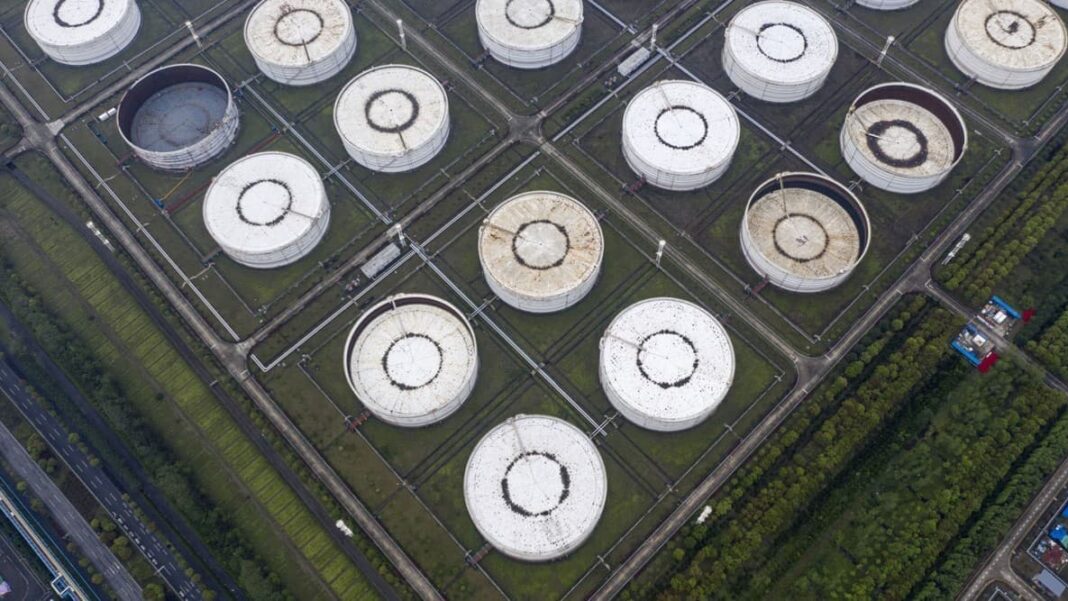
The world’s top crude oil and LNG importer, China, is not as exposed and vulnerable to energy deliveries from the Middle East as one might think.
China has been amassing crude volumes in storage for months, it has been working for years to diversify oil and gas supply sources and routes, and has boosted the share of transport electrification, which has reduced demand for road transportation fuels.
As the Middle East crisis choked off supplies via the world’s most critical oil and gas chokepoint, the Strait of Hormuz, China is more resilient to the supply shock than other regions and countries, including Europe, India, Japan, South Korea, or Southeast Asia, analysts say.
Inventory Buffer
One might think that China, as the biggest crude oil importer, would feel the supply squeeze immediately and acutely.
Yet, its supply buffer of an estimated 1.2-1.3 billion barrels of crude in strategic and commercial stockpiles could last up to four months, Rush Doshi, director of the China Strategy Initiative at the Council on Foreign Relations, told CNBC on Monday, when oil prices briefly hit $118 per barrel.
“China has taken the last 20 years to reduce some of its dependence on maritime oil flows,” Doshi said.
With pipelines and more renewable energy in the electricity mix, China depends on flows via the Strait of Hormuz for 40-50% of its seaborne crude oil imports, Doshi reckons.
Moreover, China has been amassing crude in strategic and commercial reserves for nearly a year. This oil hoarding is paying off in the unpredictable and already highly disruptive war in the Middle East.
Related: Little-Known US Company Lands Important Pentagon Contract in Rare Earth Race
China’s energy security strategy and plan to aggressively buy cheaper crude, including sanctioned barrels, is insulating the world’s second-largest economy, to some extent, from short-lived supply disruptions.
Beijing is estimated to have been amassing crude into commercial and strategic inventories for nearly a year—taking advantage of lower international prices and even lower prices for sanctioned supply out of Iran, Venezuela, and Russia.
Unlike the United States, China does not report inventories. Analysts are looking at overall supply (domestic production plus imports) and refinery processing rates to estimate how much crude is going into strategic or commercial reserves and how much is being processed into fuels.
Analysts estimate that China’s total reserves stand at between 1.2 billion barrels and 1.3 billion barrels.
“China currently holds an estimated 1.3 billion barrels of crude in onshore storage, equivalent to around four months of seaborne imports at the 2025 average rate,” Emma Li, Lead China Oil Market Analyst at Vortexa, wrote in an analysis on Monday.
Crude Flow Diversification
“China’s overall crude supply system demonstrates significant resilience to a temporary disruption at the Strait of Hormuz, supported by diversified suppliers, substantial onshore inventories, and stable pipeline inflows from Russia and domestic production,” Li said.
In the weeks before the war, China had reduced exposure to Strait of Hormuz crude oil flows, mostly thanks to the surge in purchases of Russian crude that doesn’t travel through the chokepoint in the Middle East.
The share of China’s seaborne imports transiting the Strait of Hormuz has dropped from 39% in 2025 to about 33% now, according to Vortexa data.
That’s because Chinese imports of Russian seaborne crude have jumped from around 1.2 million barrels per day in 2025 to about 1.8 million bpd now.
Related: No Magnets, No Drones: How China Controls the Future of Warfare
“Private Chinese refiners stepped up purchases as weaker demand from other Asian buyers created opportunities, reducing reliance on Hormuz-linked Iranian supplies,” Vortexa’s Li said.
Despite being the top crude importer in the world, China is less exposed to the Hormuz crisis than many other buyers in Asia, including India and the developed economies of Japan and South Korea. India relies on the Middle East for about 60% of its crude supply, while Japan’s dependence is a massive 90%.
China also continues to rely on Iranian and Russian crude, large volumes of which are already amassed in floating storage on tankers close to Chinese shores.
The independent refiners in China have been and continue to be the top buyer of Iran’s crude, while China has also been opportunistically scooping up the Russian oil that India shunned for a few months under U.S. pressure, but is now back to buying, with U.S. blessing.
Record volumes of nearly 40 million barrels of sanctioned Iranian, Russian, and Venezuelan crude are idling in floating storage on tankers near China. The crude volumes in floating storage, with more than three-quarters of the tankers laden with Iranian oil, have jumped by 17% compared to the week before the Middle East war started, according to Kpler data cited by Bloomberg on Monday.
The proximity to China and the willingness of Chinese refiners, especially the private crude processors, to buy sanctioned crude could ease – to an extent – China’s short-term pain from spiking oil prices and halted Hormuz flows.
Beijing’s vulnerability to the current supply shock varies widely across the refining sector, according to Vortexa.
Refineries with heavy Hormuz-linked supply chains or with limited substitution options could be forced to accelerate maintenance schedules or reduce processing rates.
“Overall, while China is unlikely to face an immediate nationwide refining disruption, a prolonged closure of the Strait of Hormuz would likely result in selective refinery run cuts, shifting crude trade flows, and tighter regional product balances across Asia,” Vortexa’s Li noted.
By Tsvetana Paraskova for Oilprice.com
More Top Reads From Oilprice.com
Oilprice Intelligence brings you the signals before they become front-page news. This is the same expert analysis read by veteran traders and political advisors. Get it free, twice a week, and you’ll always know why the market is moving before everyone else.
You get the geopolitical intelligence, the hidden inventory data, and the market whispers that move billions – and we’ll send you $389 in premium energy intelligence, on us, just for subscribing. Join 400,000+ readers today. Get access immediately by clicking here.