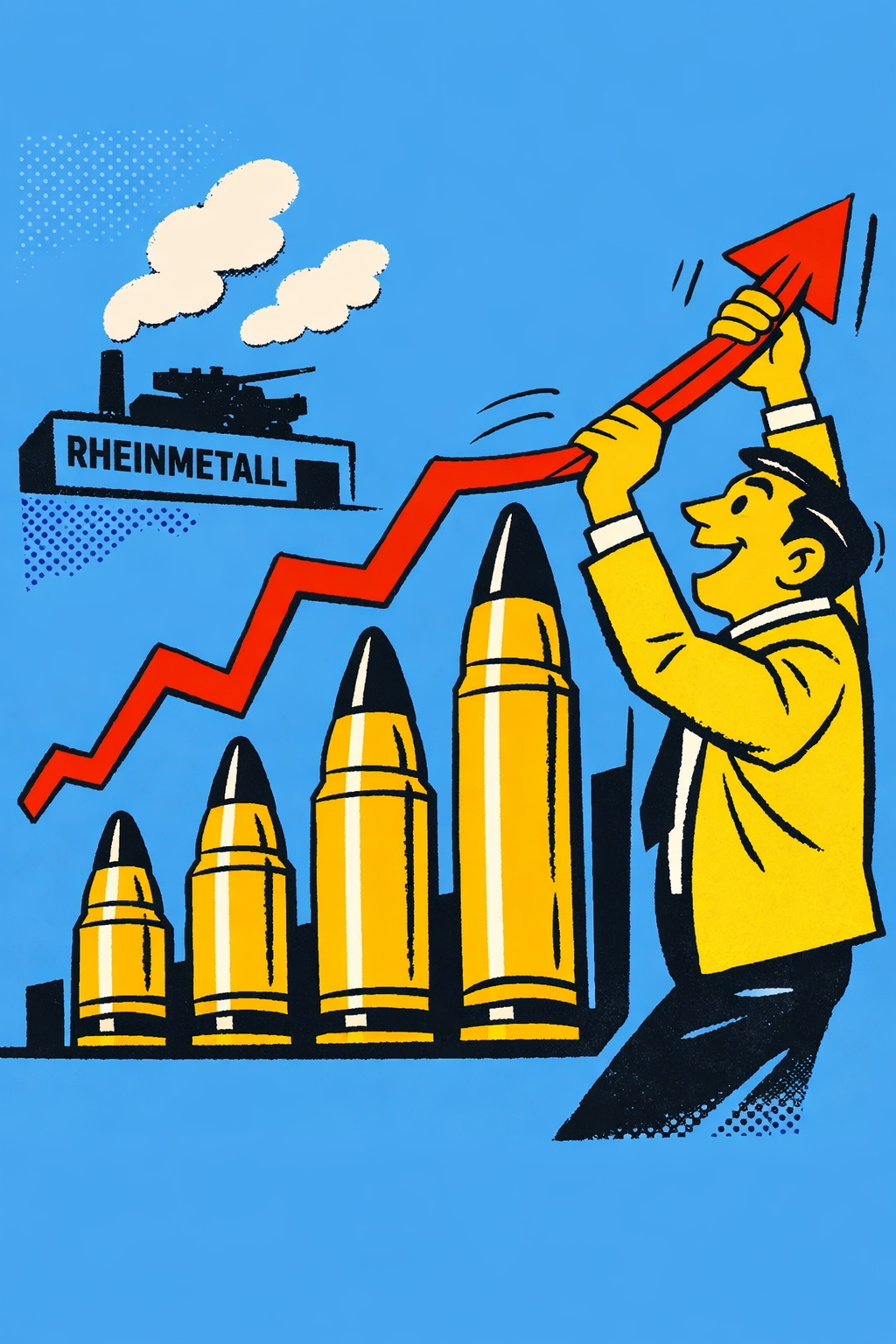
Rheinmetall’s Boom Keeps Rolling, but the Market Wants More – Moby
Rheinmetall is booming. The German defense giant just laid out another year of explosive growth, highlighted its role in replenishing missile stockpiles drained by the Iran war, and reminded investors that Europe’s rearmament story is far from over. And yet the shares dropped.
That is what happens when a company stops being a defense stock and starts being a defense expectation machine.
Rheinmetall said 2026 sales should rise by 40% to 45% to between €14 billion and €14.5 billion (about $16 billion), with an operating margin of about 19%. The company reported 2025 sales of €9.94 billion, up 29% year over year, while operating profit rose to €1.84 billion and the operating margin reached 18.5%.
Those results were solid, but they missed market expectations. Analysts had been looking for revenue closer to €10.5 billion for 2025, and forecasts for 2026 had crept toward €15 billion. The guidance therefore landed slightly light relative to the market’s most optimistic estimates.
The shares fell following the announcement despite the company reporting a record order backlog of €63.8 billion, up 36% from the previous year.
Management used the earnings release to underline how strong demand remains across the defense sector. Rheinmetall said it is in a prime position to help the US replenish missile stockpiles used in the Iran war, particularly through products such as solid rocket motors. The company said higher spending on missile restocking and air defense now appears inevitable.
The wars in Ukraine and Iran are both driving demand. Ukraine continues to fuel long-term demand for ammunition, armored vehicles, and artillery systems. The Iran conflict is adding urgency around air defense systems and anti-drone technology.
Chief executive Armin Papperger said Rheinmetall systems deployed in the Middle East had already shot down more than 100 drones during a recent weekend, highlighting the growing role of air defense in modern conflicts.
The company is also reshaping its business. Rheinmetall plans to sell its civilian automotive division in order to focus fully on defense activities. It is also expanding into naval systems following the acquisition of shipbuilder Naval Vessels Lürssen.
Rheinmetall proposed a dividend of €11.50 per share for 2025, up from €8.10 the previous year.
The muted market reaction says less about Rheinmetall’s performance and more about how the defense sector has evolved.
For the past few years the company has been one of the clearest ways for investors to play Europe’s sudden shift toward rearmament. After decades of underinvestment, governments are now scrambling to rebuild ammunition stockpiles, upgrade armored forces, and deploy modern air defense systems.
Our analysts just identified a stock with the potential to be the next Nvidia. Tell us how you invest and we’ll show you why it’s our #1 pick. Tap here.
Rheinmetall sits directly in the middle of that demand. Its core businesses include ammunition production, armored vehicles, air defense systems, and military electronics. Those are precisely the capabilities NATO members now need most urgently.
The result has been an extraordinary stock rally. Rheinmetall shares have risen roughly 540% over the past three years as the war in Ukraine and broader geopolitical tensions reshaped defense spending priorities.
But rapid success also raises expectations. Investors now assume that companies like Rheinmetall will convert rising defense budgets into immediate revenue growth. When guidance falls even slightly short of those expectations, the share price can react sharply.
In other words, Rheinmetall’s challenge is no longer proving demand exists. Demand is obvious. The challenge is proving that factories, supply chains, and procurement systems can scale quickly enough to match it.
That is the real constraint facing the defense sector today. Governments can announce spending increases overnight, but industrial production cannot ramp up instantly. Expanding ammunition plants, hiring skilled workers, and securing specialized materials can take years.
This is why investors are paying close attention to order conversion and production capacity. Rheinmetall’s record backlog signals strong demand, but backlog alone does not generate profits. Contracts must be executed, factories must deliver, and supply chains must hold together.
The Iran conflict is adding another layer of urgency. Air defense systems and interceptor missiles are being used heavily, which means stockpiles will eventually need to be replenished. That creates new opportunities for companies that can supply critical components like rocket motors and missile systems.
Rheinmetall clearly wants to position itself as one of those suppliers. If successful, it could strengthen the company’s role not only within Europe but also as an industrial partner to the US defense ecosystem.
The next stage for Rheinmetall will revolve around execution rather than demand.
Investors will focus on how quickly the company can convert its massive backlog into revenue and whether production capacity can keep pace with rising defense budgets across Europe and NATO.
Air defense, missile components, and ammunition production are likely to remain the fastest-growing areas of demand as conflicts highlight the importance of those systems.
That said, the broader trend remains intact. Europe is rearming, global security risks remain elevated, and defense spending continues to climb.
Rheinmetall appears well-positioned to benefit from that shift. The only complication is that investors already know it.
One stock. Nvidia-level potential. 30M+ investors trust Moby to find it first. Get the pick. Tap here.