


In case you were too busy cheering Bam Adebayo beating Kobe Bryant’s record for the second-highest scoring game in NBA history, you should know that the U.S. dollar is climbing while almost everything else is struggling.
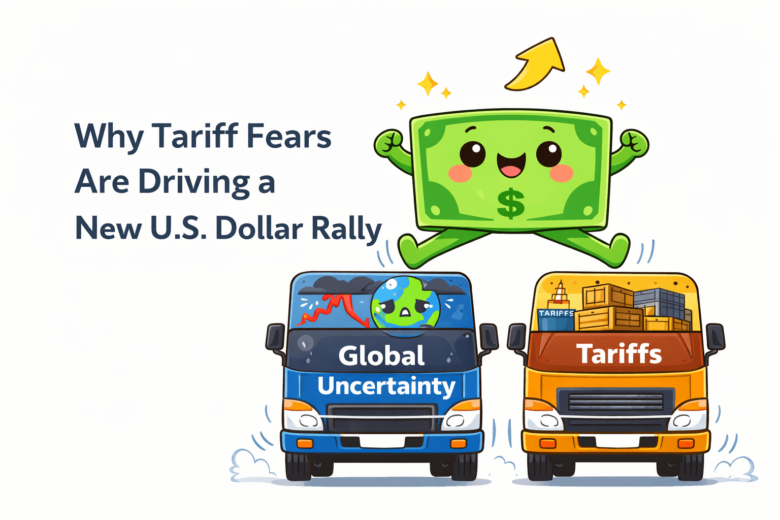
Behind the move are two powerful forces working at the same time: global uncertainty pushing investors toward safety and tariff policy adding a structural layer of support underneath.
To understand why the dollar keeps winning, you need to understand how both of these forces work and why they’re so often triggered by the same headlines.
The Basics: Fresh U.S. Tariff Threats
 The Trump administration just launched sweeping trade investigations under Section 301 of the Trade Act of 1974, targeting 17 major economies, including China, the European Union, Japan, South Korea, India, Vietnam, and Mexico.
Officials say the probes will examine government subsidies, wage suppression, and persistent trade surpluses with the United States. The goal is to develop tariff options before July 24, when the current 10% global tariff imposed under Section 122 expires.
The launch of these investigations matters beyond the legal details. After the Supreme Court struck down Trump’s IEEPA-based tariffs in February, many traders assumed the tariff story was winding down. Wednesday’s announcement was a signal that it isn’t. The administration shifted legal tools and widened scope. Trade tensions are entering a new phase, not fading out.
Markets reacted quickly.
When Fear Rises, Money Moves to Dollars
Financial markets are usually somewhere between two states: risk-on and risk-off.
In a risk-on environment, investors feel comfortable chasing returns. Money flows into equities, emerging market assets, and currencies tied to global growth such as the Australian dollar, the New Zealand dollar, the Canadian dollar.
In a risk-off environment, the calculation reverses. Uncertainty rises, and safety becomes the priority.
The U.S. dollar is one of the world’s most popular safe-haven currencies. It sits at the center of the global financial system, serves as the primary reserve currency, and is backed by the deepest and most liquid financial markets on earth.
When stress rises — whether from geopolitical conflict, financial instability, or trade friction — global capital tends to move toward dollar assets. That’s why the dollar often strengthens when the rest of the world is struggling.
What makes the current move worth paying attention to is that safe-haven demand alone isn’t driving it. There’s a second engine running underneath.
Why Tariffs Can Push the Dollar Higher
Tariffs are taxes on imported goods. When these costs rise, businesses often pass them through to consumers, pushing prices higher. That inflation pressure complicates the Federal Reserve’s position.
If inflation risks are elevated, the Fed can’t easily cut interest rates. Monetary policy stays tighter than it otherwise would, and higher rates attract global capital. Investors looking across major economies see U.S. bonds offering stronger yields than European or Japanese alternatives. To buy those assets, they first need to buy dollars — and that demand supports the dollar’s value.
The effect becomes more pronounced when monetary policy diverges across major economies.
If the Fed holds rates elevated while other central banks lean toward easing, the interest rate gap widens. Currency markets tend to reflect that gap through sustained dollar demand.
This is why tariff headlines and a stronger dollar are often seen together: tariffs raise inflation expectations, inflation expectations delay rate cuts, delayed rate cuts widen yield differentials, and wider yield differentials pull capital into USD.
Which Currencies Feel It Most
Currencies most exposed to global trade and interest rate differential tend to react first and hardest.
- EUR/USD dropped toward 1.1500 as trade friction hit the Euro Area’s export-dependent growth outlook and widened the interest rate gap in the dollar’s favor.
- AUD/USD is under the heaviest pressure, with the Aussie functioning as a global trade barometer that tends to lead the selloff among the majors when tariff fears rise.
- USD/JPY climbed toward 159.00, with the wide U.S.-Japan interest rate gap keeping the dollar on top despite the yen’s own safe-haven status.
- Emerging market currencies are getting squeezed hardest, as dollar strength makes servicing USD-denominated debt more expensive while capital flight toward U.S. assets adds further pressure.
Promoted: Stop Risking Your Own Capital on Unpredictable Trade Policies.
You’ve seen how the U.S. dollar surged on fresh tariff threats, but playing big macro shifts requires serious capital. With FundingPips, you trade a simulated account and can earn up to 100% of your rewards. Whether you’re looking for a 2 Step PRO evaluation starting at just $26 or seeking funding options up to $300K, you have the flexibility to trade your way.
Learn more about FundingPips and use code HELLO to get 20% OFF your first purchase!
Disclosure: We may earn a commission from our partners if you sign up through our links, at no extra cost to you.
Key Lessons for Traders
Follow the fear, not just the fundamentals. Currency markets move on anticipation. Traders price in the possibility of economic damage long before GDP or jobs data confirms it.
The tariff-to-dollar chain is mechanical. Tariffs raise inflation expectations, inflation expectations delay Fed rate cuts, delayed cuts widen yield differentials, and wider differentials pull capital into USD. Understanding that sequence helps you anticipate dollar moves rather than react to them.
Not all currencies weaken equally. Safe-haven currencies like the yen and Swiss franc hold up better than commodity currencies like the Aussie. Emerging market currencies tend to get hit hardest. Knowing where each currency sits in that hierarchy tells you where the biggest moves are likely to occur.
Headlines move markets before the data does. By the time official trade figures or inflation reports confirm the damage, the trade is often already crowded. The Section 301 investigations launched this week won’t produce tariff decisions for months, but markets are already pricing in the uncertainty today.
What to Watch Next
The dollar’s strength right now rests on two pillars: safe-haven demand pulling capital toward U.S. assets, and tariff-driven inflation risk reducing the likelihood of aggressive Fed rate cuts.
As long as trade policy stays unpredictable — and with 17 open investigations and a July 24 deadline forcing decisions — both pillars remain in place.
July 24 is a date to watch. What the administration does when the Section 122 tariffs expire will likely be the next major catalyst for dollar direction. A softer outcome could flip sentiment quickly. A harder one could extend the current move further.
For now, uncertainty favors the dollar, and tariffs are adding fuel to the fire.
This article is for educational purposes only. It does not constitute financial advice. Trading involves substantial risk, and past performance is not indicative of future results. Always do your own research and consider consulting with a qualified financial advisor.
Promoted: Master Your Execution During Macro Shocks
When the U.S. dollar jumps at fresh global trade jitters, does your execution stay clinical or get emotional? TradeZella’s trade replay tool lets you revisit your past trades tick-by-tick. See exactly where your entry slipped or why you hesitated, so you can dominate the next volatility spike with a data-driven playbook.
Start Your Journal with Tradezella and use code “PIPS20” to save 20% on your first purchase!
Disclosure: To help support our free daily content, we may earn a commission from our partners if you sign up through our links, at no extra cost to you.


